Your KiwiSaver is the Foundation of Your Empire!
Most people ignore it. That silence is expensive.
If you have thousands locked in KiwiSaver and you cannot clearly explain what you are in, what it costs, or whether it matches your goals — you are not “set and forget.” You are set and hope.
Surefire Empire’s KiwiSaver Self-Management module is the sensible first step in the Wealth Pyramid: Foundation — Optimise what you already have — before you chase shiny strategies higher up.
Learn the map. Take charge of your decisions. Build on solid ground.
Most Kiwis are unknowingly losing thousands, or even tens of thousands of dollars over their lifetime through high fees, poor default funds, and overly conservative strategies.
High advisor & fund fees quietly destroy your compounding
Many Kiwis pay 0.8% – 1.5%+ in fees every year. On a growing balance this adds up to tens of thousands — sometimes over $100,000+ — lost by retirement. Every percentage point matters when time is on your side.
Default funds that don’t match your goals or age
Hundreds of thousands of Kiwis stay in conservative or balanced default funds for decades, missing out on significant long-term growth. Your money is locked until 65 — it should be working much harder.
Overly conservative strategies that limit your future
Playing it too safe in KiwiSaver often means much smaller retirement savings, less freedom, and more reliance on the broken traditional system.
Lack of control and transparency
Most people have no idea what their fund is actually invested in, or how much they’re really paying. You deserve full clarity and control over your own money.
The opportunity cost is massive
The difference between an average fund and a well-managed, low-fee, high-growth approach can easily be $200,000 – $500,000+ by retirement age.
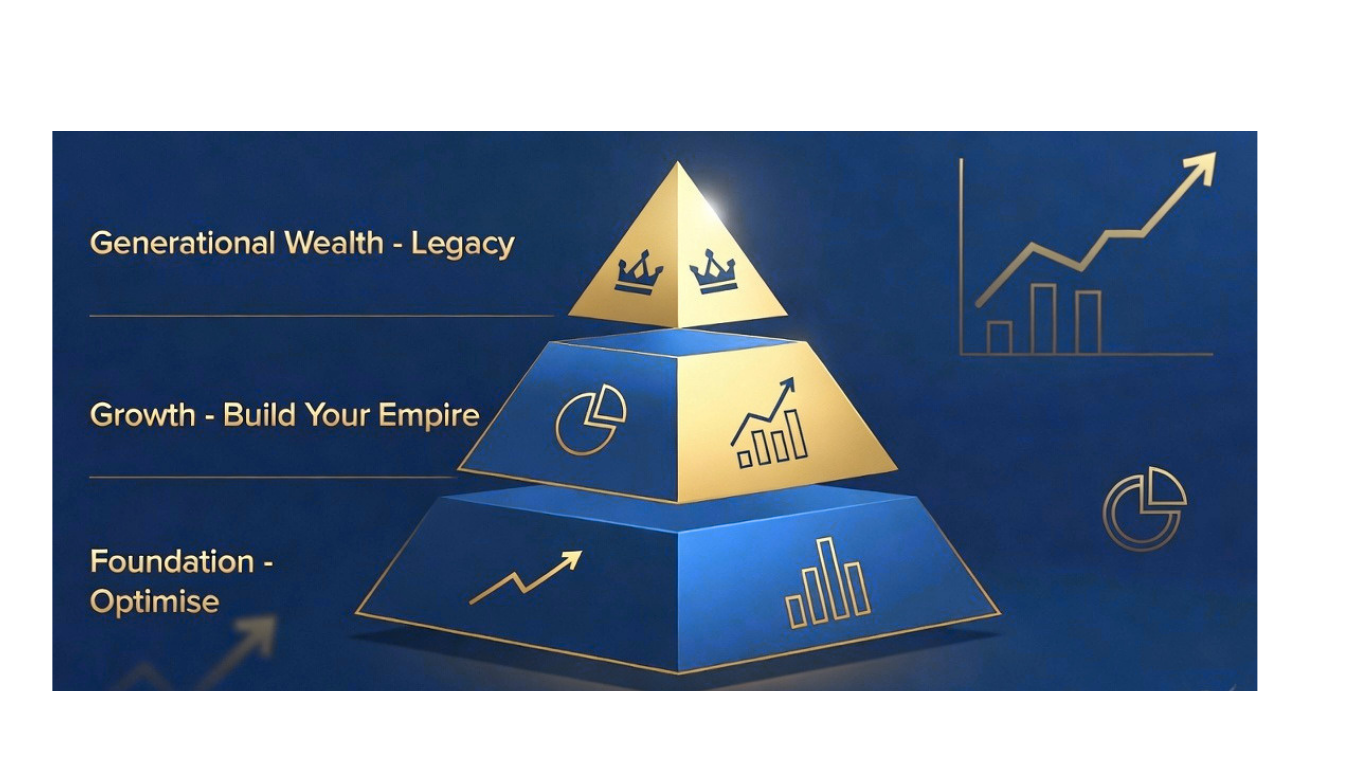
KiwiSaver Sits in Layer 1 of the Wealth Pyramid
We use a clear three-layer framework for building real, lasting wealth:
Layer 3: Generational Wealth (Legacy)
Protect, maintain, and pass on what you have built.
Layer 2: Growth (Build your empire)
Learn, grow, and automate wealth beyond the basics.
Layer 1: Foundation (Optimise)
Optimise what you already have for clear, immediate wins.
Why KiwiSaver sits in Layer 1
For most New Zealanders, KiwiSaver is one of the largest and most important assets they will ever hold — and the least understood.
Starting your “empire journey” with wealth-building tutorials, complex leverage, or shiny themes — while your KiwiSaver sits on accidental defaults, high fees, or a mix that does not match your life — is building a tower on sand.
Foundation First — Optimise the locked investment you already have. Then grow with eyes open. That is why the KiwiSaver Self-Management model is the sensible place to start.
What delaying is really costing you
Every year you wait, three quiet leaks can keep working against you — even while you “do nothing.”
1. Fund fees (the silent percentage)
Ongoing management fees are taken from your balance whether you log in or not. A small percentage charged year after year compounds against you. Many people also pay an adviser layer on top.
Illustrative education example only (not a forecast):
On a $50,000 balance, for one year, ignoring investment returns:
| Fee illustration | Provider fee | Adviser fee | Total for that year |
|---|---|---|---|
| Lower-fee style example | 0.25% (~$125) | $0 | ~$125 |
| Higher industry-style illustration | 2.00% (~$1,000) | 0.50% (~$250) | ~$1,250 |
| Difference that year alone | ~$1,125 | ||
That is ten times the fee drag in a single year — before you add years of compounding or ongoing contributions. Over decades, gaps like that can become serious money — money that never compounds for your family.
Our module teaches fee literacy using a provider with a low-fee worked example (core building blocks often around 0.25% p.a. management fee and $0 KiwiSaver member fee in our course pack figures — always verify live). Low fees do not remove market risk. They do reduce unnecessary drag.
Delay costs you understanding — and understanding is what stops the leak.
2. Adviser and dependency costs (the bill you may never itemise)
Many people pay — directly or indirectly — for advice models, product trails, and “just leave it with us” convenience.
Stack a 2.00% fund-style charge with an extra 0.50% adviser-style layer and you can be looking at roughly 2.50% per year total drag in a high-cost illustration — still taken quietly, still compounding against you.
Over a lifetime, unnecessary dependence can cost tens or hundreds of thousands in fees and opportunity you never see on a single invoice.
Greg Harkerss built Surefire Empire after four decades inside financial services as a financial adviser, credit consultant, and multi-business owner. His conclusion:
Good information changes lives.
Blind dependence can quietly tax your future.
This programme is designed to teach you how to do it yourself with clarity — so you are not stuck paying forever for decisions you could learn to own.
When you need licensed personalised advice, get it. When you need a permanent dependency, question it.
3. The wrong portfolio for your life (the expensive mismatch)
Being “in growth” when you need a house deposit soon — or “in cash-like caution” for 25 years without knowing why — is not discipline. It is drift.
Wrong settings relative to your time horizon can mean:
- • Taking risk you cannot afford when cash is needed soon (sequence risk)
- • Sitting too defensively for decades when your stated goal was long-term growth
- • Never reconciling how you feel about market falls with when you actually need the money
Delay keeps the mismatch in place. Education forces the conversation: attitude vs capacity, goals vs slogans.
Case study: Jane, age 35
What fees can quietly take over 30 years
Illustrative education case only — not a prediction of your results, not personalised advice, and not a guarantee. Returns, fees, and contributions in the real world will differ. Always verify live fees on official provider materials.
Meet Jane
Jane is 35 and earns $65,000 a year. She already has $50,000 in KiwiSaver.
She contributes 3.5% of her salary and her employer contributes another 3.5%.
She plans to keep contributing for the next 30 years until age 65.
She has two possible paths.
Path 1 — The traditional high-fee path
Jane stays with a typical high-cost illustration:
- • Provider / fund-style fee: 2.00% per year
- • Adviser-style fee: 0.50% per year
- • Total fees = 2.50% per year
Using the same contributions for 30 years, here is what the illustrative balance at age 65 looks like under three constant return assumptions:
| Investment return assumption | Illustrative balance at age 65 |
|---|---|
| 5% per year | $301,300 |
| 10% per year | $881,600 |
| 15% per year | $2,768,000 |
Over those 30 years, the illustration shows she may have paid roughly $121,000 to $566,000 in fees — money that quietly left her account month after month.
Path 2 — The Surefire Empire education path
Jane decides to educate herself. She learns how fee drag works and how to evaluate a low-cost structure.
In this illustration she uses:
- • Low-cost style fee: 0.25% per year
- • No ongoing adviser percentage fee
Same contributions. Same return assumptions. Different cost structure:
| Investment return assumption | Illustrative balance at age 65 |
|---|---|
| 5% per year | $496,900 |
| 10% per year | $1,556,900 |
| 15% per year | $5,085,900 |
The difference (extra money Jane keeps)
| Investment return assumption | Extra money Jane keeps (Path 2 vs Path 1) |
|---|---|
| 5% | +$195,600 |
| 10% | +$675,300 |
| 15% | +$2,317,900 |
The Silent Killer
Fees do not feel painful because they are taken in small amounts. But over 30 years they compound against Jane’s money instead of for her.
By lowering total illustrated fees from 2.50% to 0.25%, Jane keeps hundreds of thousands — and in stronger return environments in this model, over two million dollars — more in her own pocket.
She did not need to earn more. She did not need to contribute more. She did not need higher investment returns than Path 1.
She needed to understand how fees work and take control.
That is the Surefire Empire approach: clear education, lower-cost awareness, and the confidence to manage your own KiwiSaver decisions without paying unnecessary middlemen by default.
Jane’s outcome in this story is not luck. It is the result of knowledge.
Again: this is an educational case study with fixed assumptions. Your balance, fees, returns, and choices will differ. Education only — not personalised financial advice.
Who This is For?
This is for you if –
- You have a meaningful KiwiSaver balance (many of our members think in terms of $50,000+)
- You earn (or intend to earn) above average — and you want your locked-in investment to work as hard as you do.
- You are tired of high fees, default settings, and a “trust us” culture.
- You want education and frameworks — not another product pitch.
- You are ready to stop outsourcing every decision by default.
This is not for you if –
- You want someone else to manage your money forever.
- You want a personalised Statement of Advice without speaking to a licensed adviser.
- You are unwilling to log in, learn, and take responsibility for your own choices.
We Teach. You Decide.